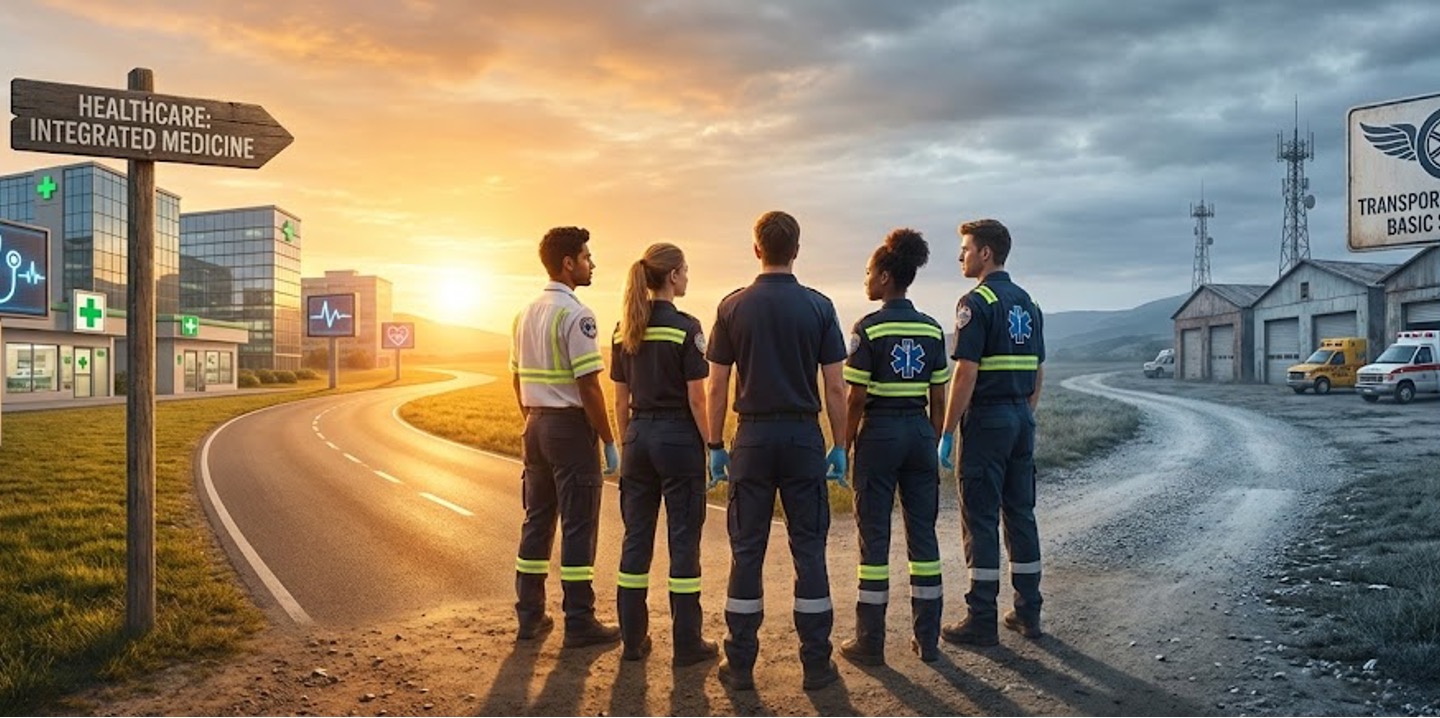
Emergency Medical Services stands at an inflection point. Artificial intelligence, advanced air mobility, and healthcare integration will define the next era. The technology is here. The federal investment is flowing. The only question is whether EMS will lead the transformation — or be reshaped by it.
The only artifact most patients receive after an interaction with EMS is the bill.
Every EMS system in America faces a defining choice. The decisions made in the next few years will determine whether emergency medical services evolves as a branch of medicine — or remains classified as transportation.
Some systems will drift toward transportation-centric models, defined by load-and-go protocols and reimbursement codes. Others will embrace a medicine-centric identity — integrating into the broader healthcare ecosystem with the same clinical authority, data infrastructure, and patient-facing technology that defines every other corner of modern medicine. The right choice is clear.
EMS defined by transport. Measured by response times. Reimbursed only when the patient rides. Disconnected from the health record, invisible to the healthcare system, and valued only for the miles traveled.
EMS as clinical medicine. Integrated into health information exchanges. Patient care records flowing to portals in real time. AI-powered documentation designed for the field. Real-time decision support at the point of care. A clinician-first approach grounded in ethics, accountability, and the same tools transforming every other healthcare discipline.
EMS clinicians operate under one of the highest cognitive loads in medicine — making critical decisions with limited information, often alone, in uncontrolled environments. AI does not erase that pressure. It redistributes it. Like an autopilot in the cockpit, AI gives clinicians the bandwidth to think clearly, act decisively, and focus on what matters most: the patient.
Up to 87% of medical diagnostic errors stem from extraneous cognitive load — not lack of knowledge, but system-created overload. Real-time decision support, AI-powered documentation, and intelligent clinical alerts are not luxuries. They are the same tools that every other corner of medicine now considers essential. EMS clinicians deserve that same support.
AI offloads the background noise — drug calculations, shock index tracking, protocol reminders — so clinicians can focus on clinical reasoning. This is not automation. It is assurance.
Generic clinical AI is not enough. EMS needs documentation intelligence built for the field — capturing scene conditions, environmental hazards, access barriers, and the clinical clues only found in the patient’s own environment. Voice-driven, context-aware, and designed for the back of a moving ambulance. AI can draft — but only the clinician can author.
The EMS clinician is often alone in the back of the ambulance. AI can be the second set of eyes — monitoring the patient, alerting for subtle changes in clinical condition, helping prevent medication errors, and ensuring protocols match the patient in front of them. Not a replacement for judgment. A partner in it.
Hospital clinicians treat patients in sterile, controlled rooms. EMS clinicians treat them in kitchens, on highways, in rain, on ice, with dogs barking and crowds gathering and the only light coming from a penlight clenched between their teeth. That context is clinical intelligence.
Generic healthcare AI captures vitals, medications, and procedures. EMS AI must go further. It must capture the scene: the icy road that delayed response by six minutes. The crowd that had to be managed before access could be gained. The living conditions that suggest a pattern of neglect. The medication bottles on the nightstand that tell a story no triage note ever will. The EMS clinician is the only healthcare provider who sees the patient in their environment — and those environmental clues are often the most important data in the entire care continuum.
Yes, we actually want to chart that it was a cold, dark, stormy night. We want to document the challenges, the barriers, and the decisions made under imperfect conditions. These details protect the clinician legally, provide context for downstream providers, and paint a complete picture of the encounter that no checkbox will ever capture.
Integration cannot be one-directional. EMS clinicians need access to patient history from health information exchanges before they arrive — allergies, active medications, advance directives, prior cardiac history. And the care they provide needs to flow back into the system immediately — to the receiving ED, to the patient’s primary care portal, to the specialists who will manage the next phase of care. A complete 360-degree view of the patient is what’s required. AI is there to make it possible, connecting the dots across systems that have been siloed for decades.
AI documentation assistants will make mistakes — just as human medical scribes and transcriptionists do. That reality does not diminish the value of the tool. It elevates the responsibility of the clinician. EMS professionals must maintain the professional accountability to review, edit, and validate every AI-generated record — confirming that it is an accurate reflection of what they saw, what they experienced, and the care they provided. The standard is not perfection. The standard is the same one that has always defined professionalism in medicine: own your chart.
AI is not neutral. It reflects the data it is fed, the assumptions it is built on, and the blind spots we fail to address. A widely used healthcare algorithm was found to systematically deprioritize Black patients by using cost as a proxy for illness. EMS cannot afford to repeat that mistake. If we integrate AI without serious scrutiny — without transparency, bias audits, and clinician oversight — we will automate injustice into our workflows.
The clinician is still in charge. AI can support decisions, but it cannot carry responsibility. Every AI tool in EMS must be explainable, field-validated, and subject to continuous human oversight. Accountability does not end when the algorithm starts — it begins with us.
When you visit your family doctor, get lab work, or have an X-ray, the results appear in your patient portal — often within seconds of the chart being completed. Push notifications. Full transparency. Immediate access. This is the baseline expectation of modern healthcare.
EMS remains outside that ecosystem. Not because the data doesn't exist — more than 64 million EMS activations are reported annually to NEMSIS, forming the largest near-real-time prehospital dataset in American healthcare. Not because the technology isn't available. But because EMS has not been integrated into the healthcare information infrastructure that every other clinical discipline now takes for granted.
The ePCR must be redesigned for EMS. Today's electronic patient care records were built for billing compliance and checkbox logic — not for the clinician in the back of a moving ambulance at 2 AM. The future ePCR must be voice-driven, AI-assisted, and built around the narrative. Structured data powers analytics, but narratives protect clinicians. A well-written EMS narrative is contemporaneous legal evidence — created in the moment, long before any complaint or investigation. AI can help clinicians tell their stories more clearly, completely, and confidently than ever before.
As AI and clinical decision support tools are rapidly adopted across hospitals and specialty medicine, EMS must choose: integrate into that ecosystem or watch the gap become permanent. Epic alone processes over 10 billion API calls monthly through an open ecosystem of more than 1,000 third-party applications. Meanwhile, most EMS ePCR vendors maintain closed, proprietary platforms that stifle innovation. That must change.
A convergence of technologies is reshaping how medical supplies, equipment, and patients move. Drones are already delivering AEDs and Narcan during live 911 calls. Electric vertical takeoff and landing (eVTOL) aircraft are in late-stage certification. Autonomous vehicles are advancing toward a future where ground ambulances navigate themselves. The question is no longer if — it's how fast, and who will lead.
Drones are delivering AEDs, Narcan, and tourniquets during live 911 calls — reaching patients in under two minutes. Beyond Visual Line of Sight (BVLOS) operations are expanding under FAA waivers, and the medical drone delivery market is projected to reach $2.5 billion by 2034. Blood products, pharmaceuticals, and organs are next.
Electric and hybrid VTOL aircraft are in FAA certification now, with initial commercial operations expected by 2027. These aircraft promise operating costs a fraction of legacy helicopters, all-weather capability, and the potential to triple annual air medical transport volume — from 400,000 to over 1.2 million patients per year. The helicopter industry will be fundamentally reshaped.
Autonomous vehicles have already logged millions of miles in major U.S. cities with dramatically fewer collisions than human drivers. Ambulance crash rates are estimated at more than six times that of all human-driven vehicles. Self-driving ambulances will free medics to focus entirely on patient care during transport, eliminate the split-attention problem that has defined ground EMS, and extend coverage in rural communities where staffing shortages leave shifts unfilled. For interfacility transfers, scheduled transports, and low-acuity calls, autonomous vehicles offer a strategic solution — not replacement, but reallocation of the workforce where it matters most.
The convergence of autonomous flight, AI-based dispatch, and distributed vertipad infrastructure will create intelligent medical transport networks. Predictive positioning will stage aircraft based on real-time demand patterns. Rural and frontier communities that have never had reliable air medical access will be connected to definitive care within minutes.
Deploying drone delivery systems with San Bernardino County, focused specifically on EMS supply delivery and emergency response integration.
Advancing both medical drone delivery and the TriFan VTOL platform — bridging the gap between small UAS logistics and full-scale air medical transport.
Building the electric aircraft and charging infrastructure for medical cargo, organ transport, and emergency logistics — with HHS contracts and air medical operator partnerships.
Furthest along the FAA certification pathway for electric air taxi operations, with defense contracts and infrastructure that will extend to medical and emergency applications.
The 2.7-tonne "Romeo" eVTOL demonstrator by ERC System, designed for patient transfers, firefighting, and remote logistics. One of the heaviest fully electric eVTOLs flown in Europe.
The "Cricket" VTOL medical evacuation drone by Avalis, designed for autonomous casualty evacuation and reducing risk to medical crews.
A comprehensive overview of AI-powered "green wave" corridors, smart stretchers, and real-time bystander video feeds for dispatchers.
Demonstrates how AI-equipped drones with built-in defibrillators can reach cardiac arrest scenes in 60 to 90 seconds, far outpacing traditional ground response.
Highlights AI-driven navigation systems that allow ambulances to reach patients faster in heavy traffic or disaster zones.
International efforts to use drone networks to reach unnavigable areas, delivering critical medical supplies where traditional infrastructure fails.
A broad overview of AI in healthcare: early disease detection, drug discovery, and personalized treatment plans — with implications for prehospital care.
Explores self-driving technology applied to emergency response, including sensor integration and potential benefits for patients and providers.
Pivotal’s innovative approach to improving EMS response times through advanced technology and data analytics.
The technologies exist. The federal investment is flowing. The frameworks are being written. The only missing element is leadership willing to demand that EMS be recognized as medicine — equipped, integrated, and accountable like it.